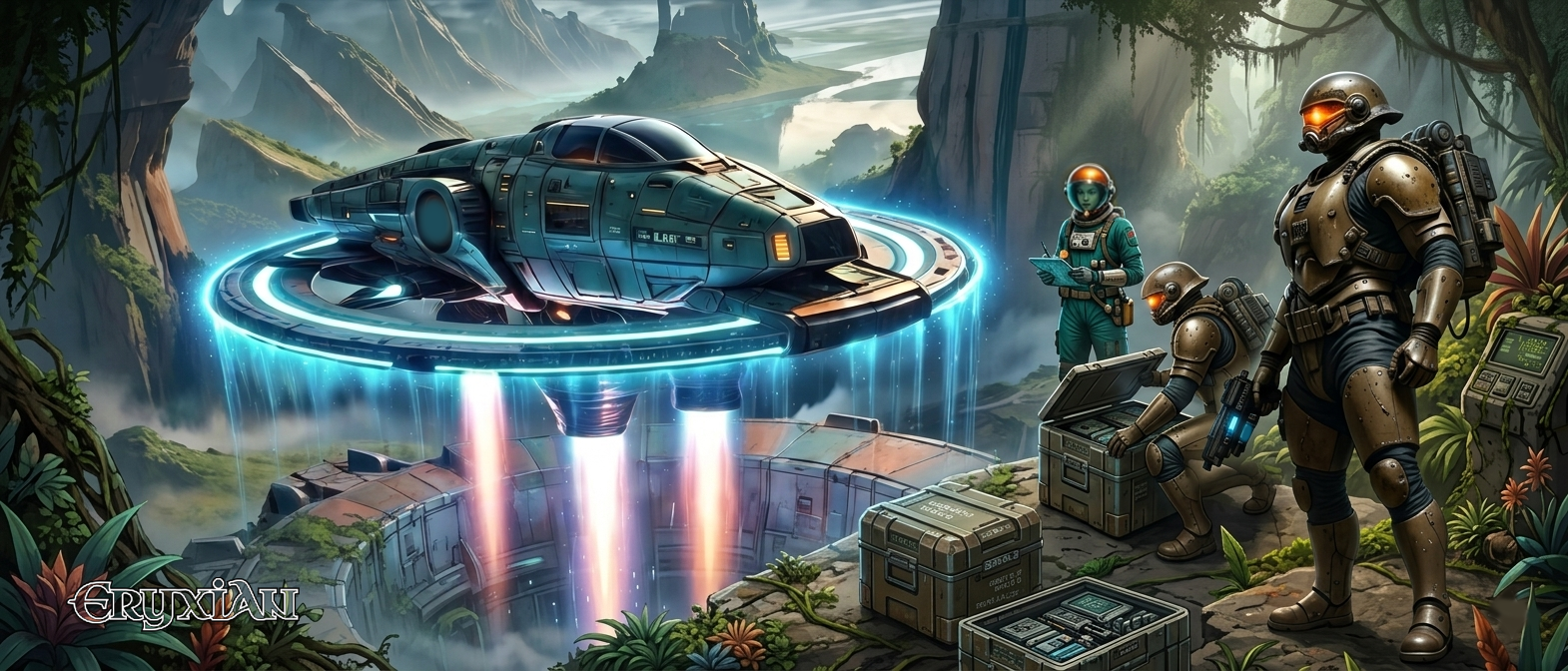
Xenotikon of Eryxian Ecosystem
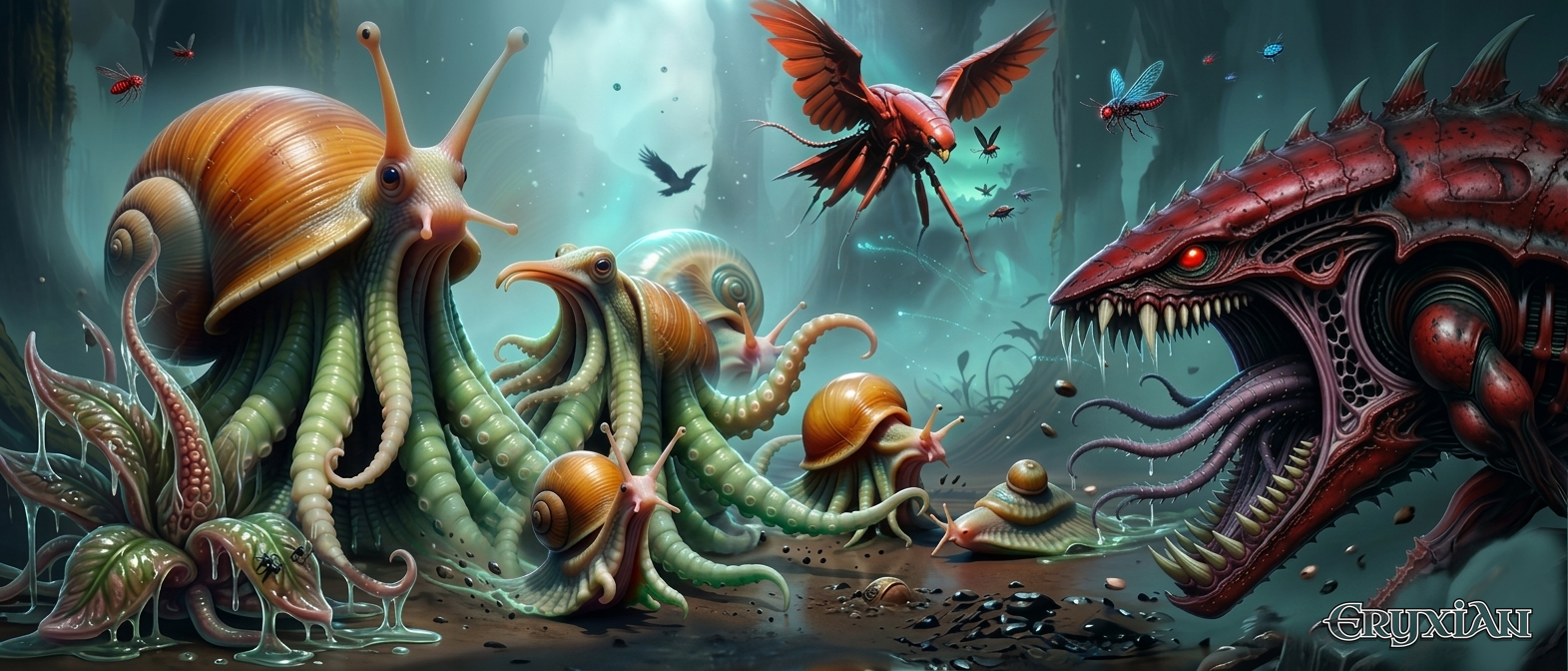
An introduction to the first systematic attempt to document what lives on Eryxia — and why "systematic" is doing considerable work in that sentence.
"I have submitted four classification proposals this season. Two were rejected on definitional grounds, one was rejected because the creature in question had changed sufficiently between my initial observation and peer review that the reviewers argued I was describing a different organism, and one was accepted provisionally — pending a note clarifying whether I believe it is actually alive in the conventional sense. I have filed the note. I am not certain of my answer."
Eryxia does not have a bestiary. A bestiary describes animals. What lives on Eryxia is not, in most cases, reducible to the category of animal — or to any single category at all. The Xenotikon is the ERYX Initiative’s ongoing attempt to document Eryxian lifeforms as what they actually are: organisms that are also systems, whose biology, life cycle, and relationship to the planet’s hyperevolutionary pressures define everything about how they behave and what they become.
It is an incomplete document. It will remain incomplete. The Chaos Cycle — the periodic cataclysm driven by the gravitational influence of Khao, the system’s distant third star — ensures that some entries documented before a Cycle event will not match anything observable after it, and that new entries will require filing. This is not a flaw in the compendium. It is the correct relationship to a planet that does not hold still.
Xenotikon Compendium for TTRPG is more elaborated in this article.
A World That Selects for the Extraordinary
To understand any individual Eryxian lifeform, it helps to understand the pressures that produced it.
Eryxia orbits within the Athe system, a trinary stellar arrangement that provides not one but three distinct sources of radiation and gravitational influence. Athe, the primary star, supplies the stable baseline that makes surface life possible at all. Nyx, a red dwarf with an eccentric orbit, arrives seasonally — the Nyx Season — bringing elevated radiation that Eryxian life does not merely survive but uses. The planet’s organisms are foundationally radiotrophic: specialized biological pigments harvest stellar radiation as a direct energy source, operating alongside or instead of photosynthetic processes. The hyperjungles of the breathable zone are not green. They are metallic, chromatic, and iridescent in ways that make terrestrial researchers reach for their instruments before they finish reaching for their field notes.
Khao, the third star, is responsible for the Chaos Cycle. Its millennia-long orbital passage exerts gravitational and radiative pressures that periodically restructure the evolutionary landscape of the entire planet. Organisms that have been stable for generations are suddenly operating under new conditions. The remarkable thing is not that the Chaos Cycle produces extinction events. It is that Eryxian life, over deep time, has become extraordinarily good at treating those events as an opportunity.
The breathable zone itself shapes everything below it. Eryxia’s dense layered atmosphere confines habitable conditions to a specific altitude band — above it, pressure fails; below, the atmospheric chemistry becomes hostile to humanoid biology. The hyperjungles, moors, freeze-jungles, and swamp systems that constitute the majority of documented biomes all exist within this band. There is, in an ecological sense, nowhere else to go. Every organism has had to learn to coexist with, exploit, absorb, or become whatever else lives within the same altitude range. The competitive and cooperative pressures this creates are, to put it mildly, significant.
"The samples we took at the bog margin on day three were still reacting to stimuli on day eleven. We have not determined whether this represents an unusually resilient tissue response or whether we should update our definition of 'sample.' The distinction has meaningful ethical implications. We are choosing not to address them until we return to base camp."
The Architecture of Transformation
The principle that most distinguishes Eryxian biology from any terrestrial model is its treatment of developmental change — not as a fixed progression from larva to adult, but as a continuous, environmentally responsive negotiation between an organism’s genetic potential and the current demands of its situation.
Every complex Eryxian lifeform begins as a relatively simple, mobile form with generalist capabilities and high genetic plasticity. What it becomes is not predetermined. It responds to radiation levels during Nyx Season, to chemical signals from prey or competitors, to physical pressures, to the genetic material it absorbs through Eryxia’s pervasive horizontal gene transfer networks. The same starting form, exposed to different conditions, can produce radically different terminal organisms. The Bloodfly Queen is not a larger Bloodfly — she is a Bloodfly that a particular set of colony pressures transformed into something categorically different. The Alpha Ripper achieves magnetodynamic abilities through a dominance-driven developmental pathway that Betas in the same pack do not share.
Crucially, these transformations are potentially reversible. An organism that has shifted toward heavy armour under competitive pressure may shed aspects of that form if conditions change. This is not regression; it is the same adaptive responsiveness operating in a different direction. The Xenotikon’s life cycle entries reflect this by treating each stage as a distinct entry connected by explicit chain notation — and by documenting trigger conditions wherever they are known, because the trigger is often the most important information available.
The Chaos Cycle does not merely threaten these organisms. It accelerates the process to an extent that makes post-Cycle survey data largely incompatible with pre-Cycle baselines. Researchers who have attempted to compare the two have filed notes ranging from “significant morphological divergence” to “I do not believe this is the same species” to, in one documented case, simply a question mark submitted as a formal addendum.
How the Xenotikon Classifies
Because Eryxian lifeforms resist single-axis description, the Xenotikon employs six classification axes simultaneously. Together they define not just what a creature is, but how it behaves, where it fits in the food web, and what it does when encountered by researchers, hunters, or anyone else unfortunate enough to be in the same zone.
Biological Class establishes the broadest structural category: arthropoid, chordate, mycelial, cephalopoid, labyrinthine, colonial, and several classes that exist primarily because the organisms assigned to them actively resist more specific categorisation. The Undefined designation is not a placeholder. It is the Xenotikon’s acknowledgment that some organisms have made their position on human taxonomy clear.
Ecological Niche describes where in the food web the organism operates and how that position shapes its default behaviour. An apex predator and a sentinel organism may be equally dangerous in an encounter, but for different reasons and with entirely different dynamics. A decomposer that feeds on defeated matter and triggers further transformation events in the zone is a mechanical factor in ways that exceed its apparent threat level.
Scale Tier situates the organism within the broader size and threat hierarchy — from microscopic colonial organisms forming atmospheric plankton layers to apex megafauna whose territorial ranges span multiple operational theaters.
Life Cycle Stage accounts for the fact that a juvenile and a mature specimen of the same lineage may present as entirely different threats. A Spawner colony is a puzzle. The Spawn it produces is a reckoning. The Xenotikon documents the chain, not just the end point.
Technology Relationship records how the organism responds to equipment, machinery, and the various technological artefacts left behind by civilisations that have passed through this system. Some organisms disrupt technology. Some are attracted to energy signatures. Some incorporate abandoned machinery into their biology through the same adaptive processes that shape everything else about them. The Nethermancer does something to active equipment that seven separate research teams have attempted to describe mechanistically. None of the descriptions agree.
Ancient Connection addresses the subset of organisms that behave in ways consistent with deliberate design — not evolved, but engineered, shaped, or still responding to systems installed by the civilisation that preceded everything currently documented on Eryxia. The Octogoth has no traceable evolutionary lineage. The Living Labyrinth responds to Ancient signals in ways that the ERYX Initiative’s instruments can detect but not explain. The Nethermancer may not be a biological organism in any meaningful sense. The Xenotikon preserves all possibilities. The evidence has not yet closed any of them.
"We asked the senior Conclave hunter what the creature's weak point was. She considered this for a while and said: 'It does not have one yet. Check again after it has had a chance to know you.' We have logged this as behavioural data. It has not stopped being unsettling."
What the Conclave Already Knows
The ERYX Initiative spent considerable resources developing classification frameworks before anyone formally consulted the Conclave about what they already called these things, what they already knew about them, and how they had already been living alongside them for generations.
The Conclave’s approach to the creatures of Eryxia is relational rather than taxonomic. An organism is understood by what it does to its environment — what it protects, what it hunts, what the Chaos Cycle has done to its lineage, and what ritual relationship the Conclave has developed in response. Some creatures are hunted. Some are protected. Some are sacred. The Hydra occupies an unusual position in all three categories simultaneously, and the Conclave considers this entirely consistent.
The Xenotikon now incorporates Conclave relational knowledge alongside ERYX Initiative mechanical profiles. Where the two systems disagree — and they do, on matters ranging from classification to intent to whether certain organisms should be approached at all — both entries are preserved. The planet has not issued a correction to either party. Both, in the current assessment, may be correct.
An Incomplete Compendium
The full Xenotikon documents confirmed lifeforms across Eryxia’s major biomes: the apex predators of the hyperjungles, the colonial organisms whose threat scales with group size, the environmental entities that are less creatures than they are ecological events, and the Undefined category that exists because some organisms have made their preference for remaining unclassified into something that functions, mechanically, as a defence.
Each entry includes a behaviour profile, a life cycle chain where documented, a technology relationship, and notes on what the Conclave calls it and why. Each entry also includes what a defeated specimen yields — because in a hyperevolutionary ecosystem, even the biology of a dead organism is information, and that information is often more useful than the classification that preceded it.
The compendium is not exhaustive. It cannot be. But it is the most thorough account currently available of what lives on Eryxia, how it came to be what it is, and what it is likely to do next.
Which is the most anyone has managed to say about this planet with confidence.
© Daniel Sandner 2024–2025 · Eryxian Universe · CC BY-SA 4.0 “Classification is a human impulse. The planet files nothing.”