
Card Codex TCG: Selection
Codex Eryxian Legacy TCG: Showcase of Selected Cards, Design Notes, and Lore
Table of Contents
For full list of Eryxian TCG editions, check this application:



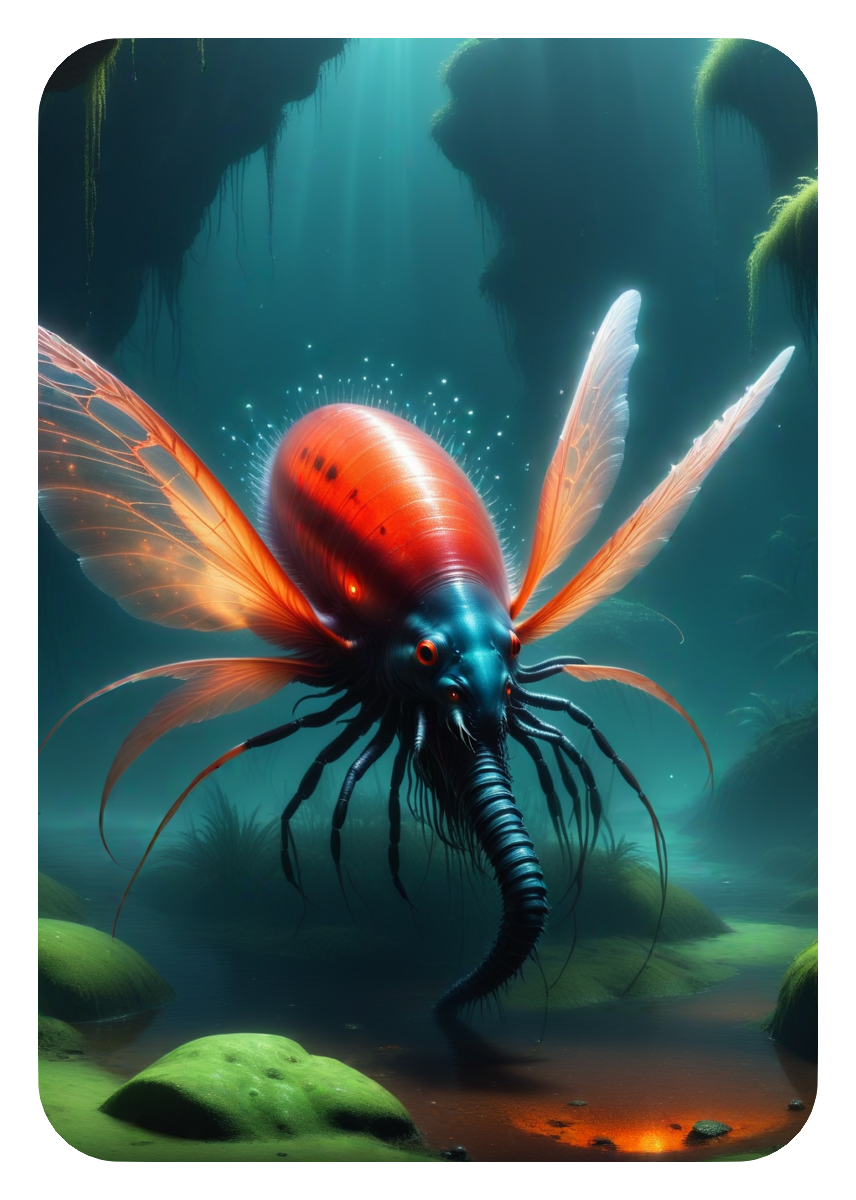
The basic unit of Eryxian swarm ecology — a rather small, bigger Earth bird size, aggressive flying organism that feeds on radiation-rich biological matter. Bloodflies are everywhere on Eryxia and in any environment where Eryxian contamination has spread. They are individually trivial but collectively devastating. The instant damage on Play represents the Bloodfly's first-strike instinct: it always attacks before establishing itself. They do not hesitate. Roughly insectoid but with too many wing-membranes, a mouth-apparatus that pulses with bio-electrical discharge, and compound eyes that reflect a dozen perspectives at once.
 Alpha
Alpha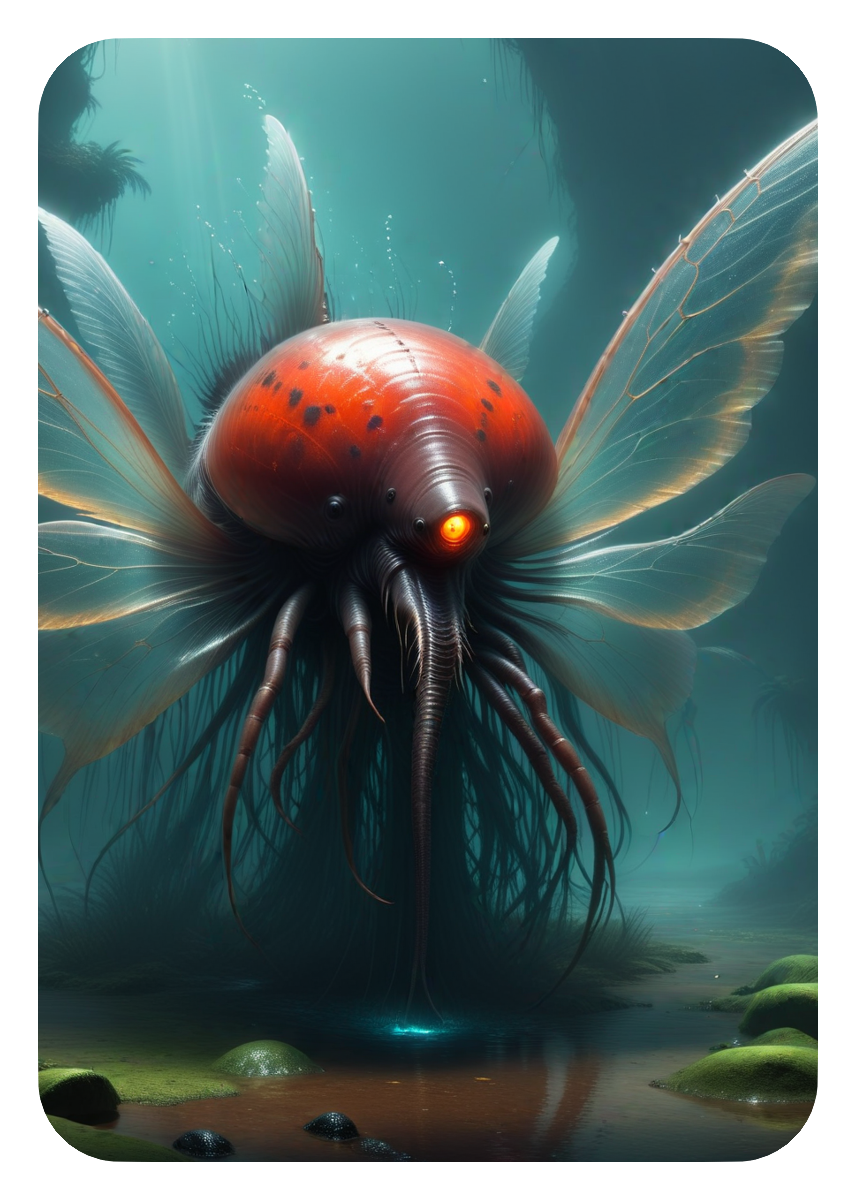 Bloodqueen
 Alpha
Alpha Beta
Beta
The Gastropoid is an Eryxian organism whose flux-absorption capacity varies wildly depending on ambient radiation conditions at the moment of "activation" (Play). On Eryxia, flux intensity determines how much MHD energy an organism can store in its biological capacitors — a Gastropoid born during a Scorched Cycle high has enormous resilience; one born in a shadow period is fragile. The dice represents this natural variance. No two Gastropoids are the same.
 Alpha
Alpha AlternateAlphaBeta
HUMANS
Humanity in the Eryxian universe is fractured across multiple factions (TAM, Stellar Concord, FHC, UESC) but the card faction “Humans” represents a generalized human military and technological apparatus — the industrial-martial culture that humans default to when survival is the priority. Their cards reflect combined-arms doctrine: infantry, vehicles, fortifications, and command structures working in layered synergy. They are not the strongest or the most exotic, but they are relentless, adaptable, and organized.
ARMORED COMMANDER
Type: Character | Cost: 4 | Attack: 3 | HP: 5 | Keyword: Defender
Lore Logic: A field commander in TAM or Stellar Concord heavy combat armor. The Defender keyword is not defensive cowardice — it is tactical positioning. Commanders hold the line while coordinating flanking maneuvers. Their armor suits integrate heads-up tactical overlays, squad-link comms, and reactive plating. They exist to absorb fire while their soldiers execute. An Armored Commander killed early is a catastrophic morale blow, which is why they are trained to anchor positions. A heavily-armored human soldier — plate suit reminiscent of powered exo-armor, shoulder-mounted tactical antenna array, visor opaque and glowing amber.
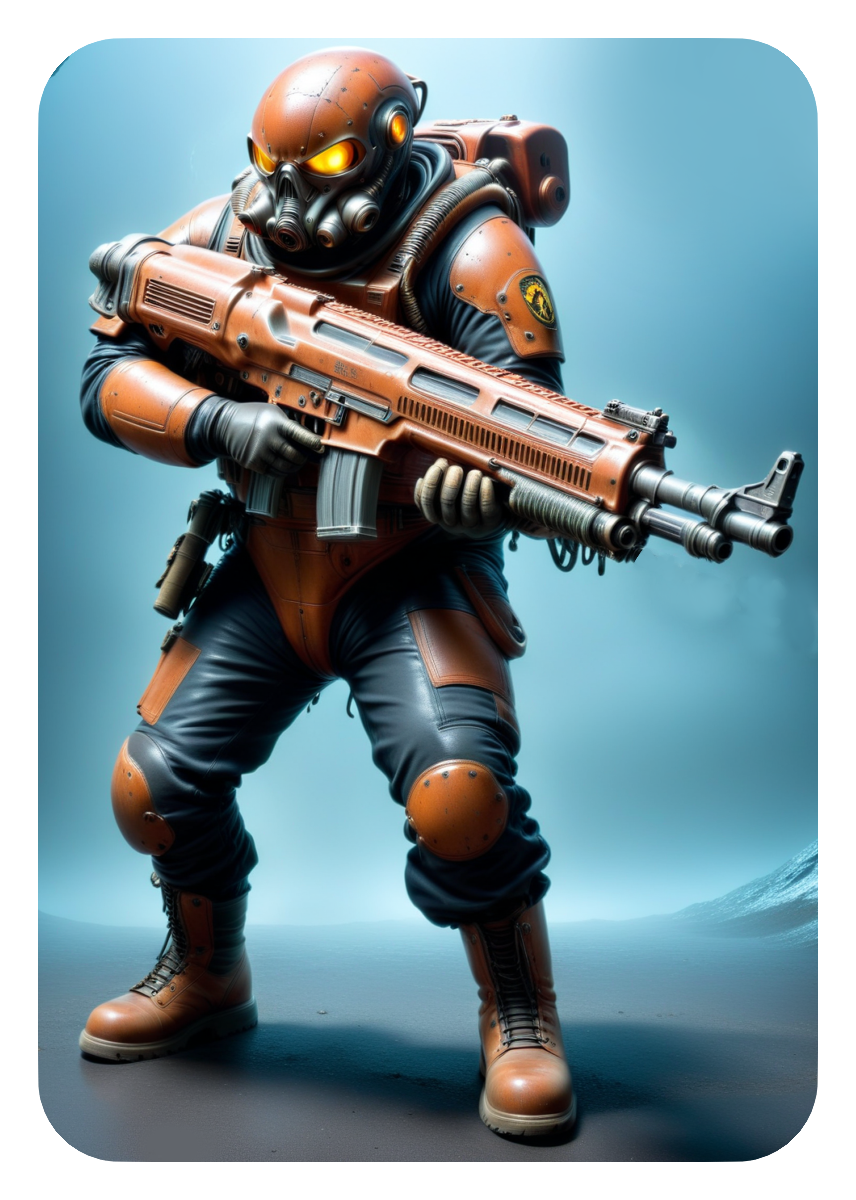
Heavy infantry in ballistic plate and energy shielding — the human frontline anchor. Taunt represents their trained role: drawing enemy fire so lighter, faster units can maneuver. Armored Infantry don't flinch, don't retreat, and are armored enough to survive what hits them. In human combined-arms doctrine, these soldiers are the anvil that holds while the hammer falls elsewhere.
 Alpha
Alpha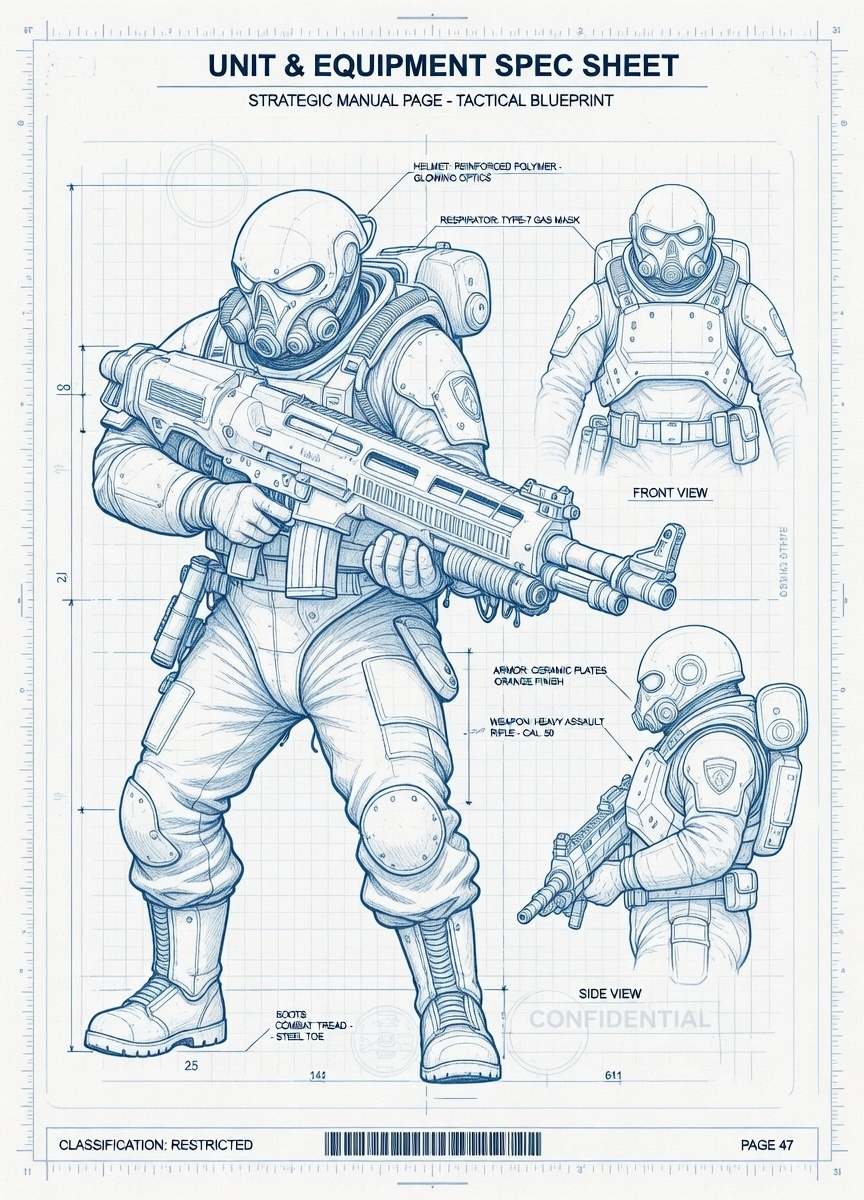 BetaAlphaBeta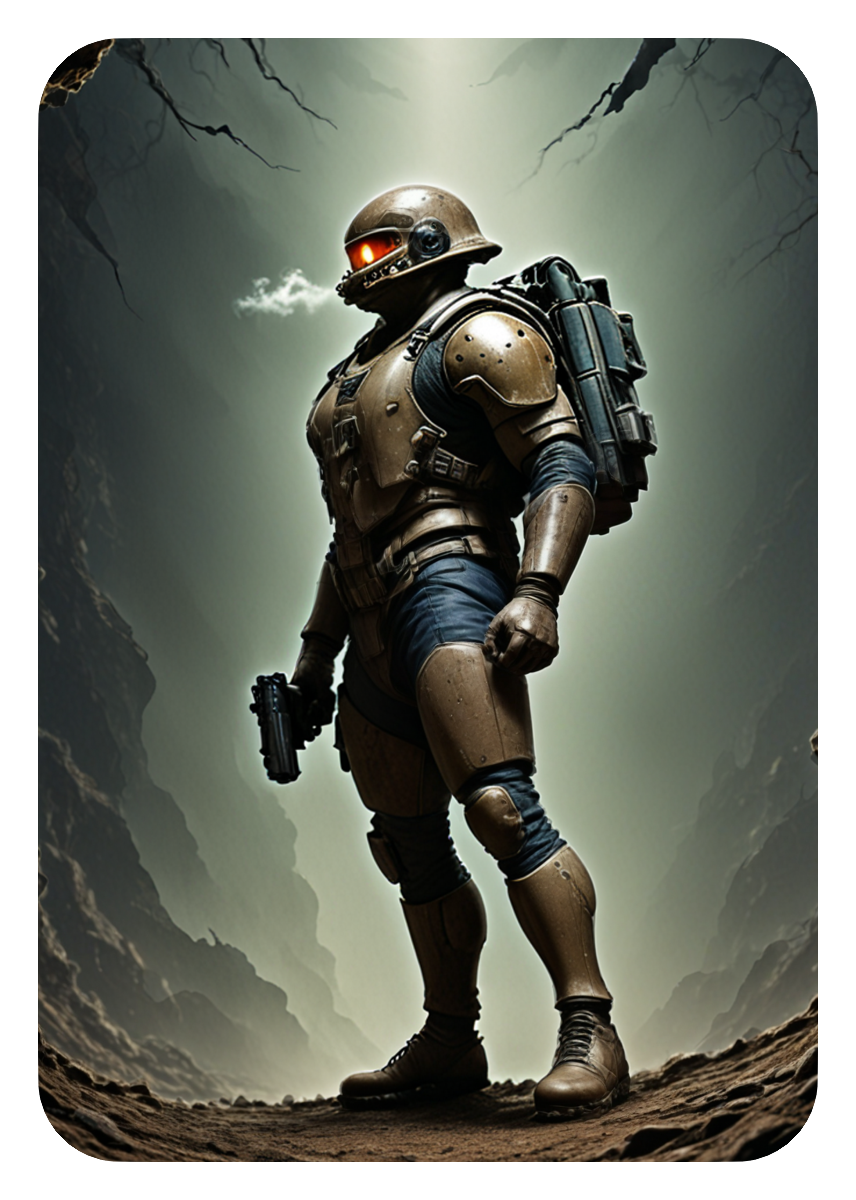
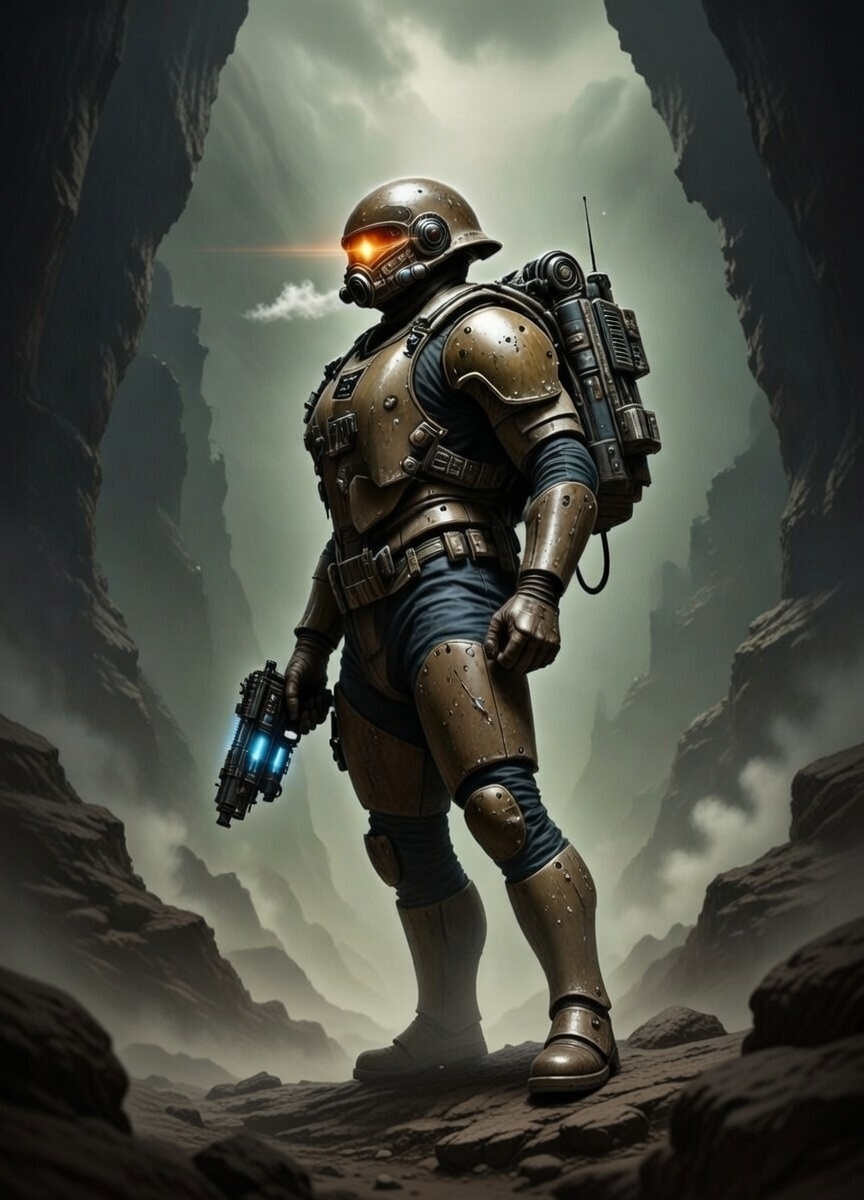
The basic human grunt — not special, not exceptional, entirely expendable in the calculus of faction warfare. The Death trigger (draw a card) represents a grim truth: in human military culture, the death of a soldier generates paperwork, battlefield reports, tactical data. Every fallen soldier feeds the machine. The lesson learned from their death is recorded and distributed. They are the universe's most abundant military resource and its most spent one. A lone soldier in standard-issue armor, walking forward in a vast emptiness — a battlefield rendered minimal. Small, isolated against the scale of the conflict.
 BetaAlphaBeta
ASSAULT HOVERTANK
Type: Character | Cost: 4 | Attack: 4 | HP: 2 | Keyword: Fury
Lore Logic: Human hover-armor is a staple of TAM rapid assault doctrine. Low HP represents its vulnerability to flanking and anti-armor munitions — it’s fast and devastating but not built to absorb punishment. Fury (attacks immediately) captures the doctrine perfectly: the Assault Hovertank is not a siege weapon, it’s a shock weapon. It rushes in before defenders can reposition, unleashes overwhelming firepower, and either breaks the line or burns out.
BATTLE ENGINEER
Type: Character | Cost: 3 | Attack: 2 | HP: 5 | Effect: Effect damage +1
Lore Logic: Engineers are the backbone of sustained human military operations — field-repairing armor, rerouting power to weapons, rigging improvised munitions. The +1 effect damage represents their ability to optimize every weapon system they can touch: boosting charge on plasma rifles, overclocking targeting systems, adding secondary detonators to grenades. They aren’t frontline fighters but they make everything around them hit harder.
EXOSKELETON
Type: Character | Cost: 6 | Attack: 6 | HP: 6 | Effect: Cast (3): Deal 2 damage
Lore Logic: Full powered exoskeleton — not a vehicle, not quite a person. A human pilot sealed inside a walking weapons platform, bridging infantry and armor. The Cast ability represents the internal weapons system being activated on a targeting solution: the suit has its own onboard armament (micro-missiles, directional charged emitters) that can engage targets independently of the pilot’s physical reach. These are rare and expensive — every Exoskeleton represents a massive resource investment. A towering bipedal mech-suit, 3-4 meters tall, with a visible cockpit viewport showing the human or augmented pilot inside.
ARMORED INFANTRY
Type: Character | Cost: 4 | Attack: 3 | HP: 6 | Keyword: Taunt
Lore Logic: Heavy infantry in ballistic plate and energy shielding — the human frontline anchor. Taunt represents their trained role: drawing enemy fire so lighter, faster units can maneuver. Armored Infantry don’t flinch, don’t retreat, and are armored enough to survive what hits them. In human combined-arms doctrine, these soldiers are the anvil that holds while the hammer falls elsewhere.
FLAMETHROWER
Type: Equipment | Cost: 2 | HP: 2 | Effect: Attack +1
Lore Logic: Thermal projectors with condensed accelerant tanks — issued to human units for clearing enclosed spaces, xenological infestations, or forcing enemies out of entrenched positions. Against Eryxians in particular, flame weapons are controversial but tactically effective (disrupting biological networks and Flux patterns). The modest Attack bonus reflects their limited range and splash limitations in open field.
HOVERTANK
Type: Character | Cost: 7 | Attack: 7 | HP: 7
Lore Logic: The mainline human hover battle tank — no special abilities because it doesn’t need any. This is the baseline juggernaut of human armored doctrine. It has superior firepower, superior armor, superior everything. Its cost and raw stats represent the enormous resource expenditure required to field and sustain one. When a Hovertank enters the battlefield, it is a statement: we have the industrial capacity to deploy the best. A massive, imposing hovertank — multiple times larger than the Assault Hovertank.
SENTINEL
Type: Character | Cost: 3 | Attack: 2 | HP: 5 | Effect: +3 attack during opponent’s turn
Lore Logic: Sentinels are specialists trained in reactive and overwatch combat — the equivalent of a counter-ambush unit. In human military training, Sentinels spend weeks learning to identify and respond to enemy-turn threats (incoming charges, flanking maneuvers) with heightened precision and aggression. They actually fight better when reacting than initiating. The “bonus attack on opponent’s turn” is a mechanization of overwatch fire doctrine. The second the enemy commits, the Sentinel is ready.
SOLDIER
Type: Character | Cost: 1 | Attack: 1 | HP: 1 | Effect: Death: Draw a card
Lore Logic: The basic human grunt — not special, not exceptional, entirely expendable in the calculus of faction warfare. The Death trigger (draw a card) represents a grim truth: in human military culture, the death of a soldier generates paperwork, battlefield reports, tactical data. Every fallen soldier feeds the machine. The lesson learned from their death is recorded and distributed. They are the universe’s most abundant military resource and its most spent one. A lone soldier in standard-issue armor, walking forward in a vast emptiness — a battlefield rendered minimal. Small, isolated against the scale of the conflict.
SCIENTIST
Type: Character | Cost: 3 | Attack: 1 | HP: 4 | Effect: Effect damage +1
Lore Logic: A battlefield or embedded research scientist — not a fighter, but invaluable. They optimize weapon signatures, analyze Eryxian biomes in real time to suggest targeted damage methods, and tune effect-based weapons for maximum efficiency. The +1 effect damage represents scientific optimization: the Scientist doesn’t pull the trigger, but every trigger pulled after their analysis hits harder. In the Eryxian universe, science is as much a weapon as a gun.
TACTICAL DROPSHIP
Type: Character | Cost: 8 | Attack: 8 | HP: 6 | Keyword: Effect Immunity
Lore Logic: A heavily-armored military dropship operating within atmosphere — not a starship, but close. Effect Immunity represents its electronic countermeasure suite: hardened against EMP, psionic disruption, Eryxian flux effects, Collective override signals. The TAM and Stellar Concord deploy these for high-value extractions and force projection in hostile environments. They are expensive, slow to deploy, and terrifyingly effective. The 8-cost reflects a strategic-level asset.
Visual Brief: A massive, wedge-shaped dropship descending through a storm-lit sky, engines on full reverse thrust. It looks armored beyond reason — every surface has ablative plating, countermeasure pods, sensor baffles. A ramp beginning to open at the rear, silhouettes of troops inside. The ship itself feels like a weapon as much as a transport. Colour palette: dark military gunmetal with running lights in red and white, storm clouds and lightning behind, engine glow in electric blue.
ERYXIANS
Eryxians are the native biosphere of Eryxia — a radiotrophic, flux-sensitive ecosystem shaped by three suns, intense radiation, and the Scorched Cycles. They are not a civilized faction in the human sense: they do not use technology, do not communicate in standardized language, and operate on biological imperatives refined by millions of years of extreme-environment evolution. Their cards represent individual organisms, swarms, and biological phenomena. Playing Eryxians is playing nature: resilient, mutating, unpredictable, and utterly alien.
ARACHNOCTOPUS
Type: Character | Cost: 6 | Attack: 5 | HP: 6 | Effect: Play: Give +2/2
Lore Logic: A large ambush predator native to the Labyrinthine caves of Eryxia — it combines radially-symmetric arthropod limbs with cephalopod-like adaptability. The Arachnoctopus is an apex threat in its habitat: it doesn’t just kill, it dominates the space, suppressing other predators and enabling smaller prey-catchers to operate freely (the +2/2 to an ally reflects its territorial control). Its arrival on the battlefield signals the establishment of Eryxian dominance over a zone.
Visual Brief: A massive multi-limbed creature — eight chitinous legs with a fluid, boneless upper-body capable of reshaping itself. Bioluminescent patterns along its mantle pulse in deep crimson and violet. It’s in a mid-crouch dominance posture, limbs spread, the ground around it showing smaller creatures scattering to take positions. Background: Eryxian cavern — dark stone lit by bioluminescent fungi and reflected radiation. Colour palette: deep obsidian chitinous body, blood-red and violet bioluminescence, cave-amber ambient glow.
BLOODFLY QUEEN
Type: Character | Cost: 3 | Attack: 2 | HP: 2 | Effect: Play: Deal 1 damage
Lore Logic: The Queen is not a fighter — she is a biological command node. Bloodflies (see Bloodfly) operate as an extension of the Queen’s pheromone network; when she arrives in a new territory, the swarm immediately agitates and attacks whatever she designates as threat. The instant damage on Play represents the swarm re-orienting the moment she appears — a ripple of aggression through the hive triggered by queen-pheromone shifts.
Visual Brief: A creature that is somewhere between insect royalty and eldritch horror — larger than her drones, with a distended abdomen sac and elaborately patterned wing-casings folded behind her. A floating cloud of Bloodfly drones orbit her like a corona. Her face is an eyeless mask of sensory organs. The single drone she gestures at is already accelerating toward a target. Colour palette: deep burgundy and black chitinous shell, gold patterning on the wing-cases, a cloud of dark moving specks.
HARBINGER
Type: Character | Cost: 4 | Attack: 4 | HP: 5 | Effect: Cast (2): Roll D6, on 4+ return target to hand
Lore Logic: A large migratory Eryxian that precedes territorial shifts — it appears before swarm events, Scorched Cycles, or major flux disruptions. Its ability to return targets to hand represents its natural behavior: Harbingers are biological disruptors, they do not directly kill but physically displace other organisms — roaring, charging, imposing their mass to force creatures out of territories. The dice roll captures the unpredictability of a biological disruption vs. a precise weapon.
Visual Brief: A massive, bioluminescent Eryxian creature in mid-territorial display — head raised, acoustic organs vibrating, the air visibly distorted around it with focused sound pressure. Behind it, smaller organisms are visible fleeing in all directions. Its posture communicates displacement rather than destruction. Background: open Eryxian surface near a Labyrinth entrance, triple-sun sky. Colour palette: deep green-brown organic plating, orange-yellow bioluminescence on acoustic organs, triple-sun sky in amber and red.
SWARM
Type: Character | Cost: 3 | Attack: 3 | HP: 5 | Keyword: Regeneration
Lore Logic: Not one creature — a coordinated swarm of smaller Eryxian organisms operating as a collective biological unit. Regeneration is biologically accurate: individual organisms in the swarm die constantly, but the swarm as a whole continuously replenishes from the surrounding environment, drawing in new organisms from the local biome. You cannot kill a Swarm by attrition alone — its mass is not static. It is a living tide that heals because its components are everywhere.
Visual Brief: A dense, churning mass of insectoid and cephalopod micro-organisms — individually barely visible, but collectively forming a roiling, coherent shape that has a pseudo-face of shifting parts. Pieces of the swarm constantly detach and reattach from the environment. The background “leaks” into the swarm and vice versa — it’s unclear where the swarm ends and the environment begins. Colour palette: murky dark greens and browns, flickers of bioluminescence in the depths of the mass.
LABYRINTH TRAP
Type: Secret | Cost: 3 | Effect: Trap — Paralyse the next attacker
Lore Logic: The Eryxian Labyrinths are not static structures — they are quasi-living entities, mobile and reactive, constructed from compressed exotic matter by the Ancients but long since colonized and integrated into the Eryxian biosphere. They develop organic defense mechanisms: chambers that contract, floors that exude paralytic bio-compounds, walls that close. The Labyrinth Trap is the Labyrinth itself defending against intrusion — the organism’s immune response to a foreign attacker.
Visual Brief: An organic tunnel corridor that doesn’t look carved — it looks grown. Walls of compressed bioluminescent matter, passages that seem to breathe. In the foreground, a trigger-membrane stretched across the floor, nearly invisible. An attacking creature’s foot just crossing it. The walls behind the membrane already beginning to close and contract. Colour palette: deep alien blue-green living stone, pale yellow luminescent membrane, dark amber trigger-light.
GASTROPOID
Type: Character | Cost: 4 | Attack: 1 | HP: variable (D6) | Effect: Play: Roll D6 to know your HP
Lore Logic: The Gastropoid is an Eryxian organism whose flux-absorption capacity varies wildly depending on ambient radiation conditions at the moment of “activation” (Play). On Eryxia, flux intensity determines how much MHD energy an organism can store in its biological capacitors — a Gastropoid born during a Scorched Cycle high has enormous resilience; one born in a shadow period is fragile. The dice represents this natural variance. No two Gastropoids are the same.
Visual Brief: A large, amorphous gastropod creature — its shell not rigid but compressed flux-matter, reforming constantly. Multiple sensory stalks, and a body that seems to inflate and deflate as it “decides” how much radiation to absorb. Its HP is literally its current charge level — visible as a glow intensity under the shell skin. Background: Eryxian surface with visible radiation shimmer in the atmosphere. Colour palette: translucent amber shell, deep gold internal glow (brighter for high rolls, barely visible for low), dark alien soil.
HYDRA
Type: Character | Cost: 7 | Attack: 7 | HP: 9 | Keyword: Immunity
Lore Logic: An apex Eryxian megafauna — a multi-headed biological titan that has evolved to survive every environmental threat Eryxia can produce: radiation, extreme temperature flux, chemical corrosion, biological toxins, and physical trauma. Immunity reflects its biological redundancy: multiple nervous systems, distributed vital organs, regenerative tissue at the cellular level, and a hull-like dermal armor layer that has no known equivalent in manufactured materials. The Hydra is as close to a living weapon as nature produces. Can evolve into a massive, multi-headed creature — each head distinct in sensory specialization (thermal, chemical, sonic, visual). Its body is an armored fortress of overlapping organic plates. The background shows it absorbing punishment that would destroy anything else — explosions, energy discharges, biological toxins — and continuing to advance unimpeded.
BLOODFLY
Type: Character | Cost: 2 | Attack: 1 | HP: 1 | Effect: Play: Deal 1 damage
Lore Logic: The basic unit of Eryxian swarm ecology — a rather small, bigger Earth bird size, aggressive flying organism that feeds on radiation-rich biological matter. Bloodflies are everywhere on Eryxia and in any environment where Eryxian contamination has spread. They are individually trivial but collectively devastating. The instant damage on Play represents the Bloodfly’s first-strike instinct: it always attacks before establishing itself. They do not hesitate. Roughly insectoid but with too many wing-membranes, a mouth-apparatus that pulses with bio-electrical discharge, and compound eyes that reflect a dozen perspectives at once.
LABYRINTH OF RENEWAL
Type: Artifact | Cost: 2 | HP: 5 | Effect: Start of turn: All Eryxian and Ancient cards heal by 3
Lore Logic: A section of active, mobile Labyrinth that the Eryxians have integrated into their deployment. The Labyrinth exudes a constant flux field that functions as a biological restoration matrix — the same process that sustains Eryxian life in hostile conditions, here deployed as tactical support. The healing applies to Ancients as well as Eryxians because both are MHD-flux-based entities: Ancient constructs respond to the same MHD frequency as Eryxian biology. A towering Labyrinth structure — not mechanical, not entirely stone. It rises from the ground like a grown thing, often covered in moss or dry mud, or vines which are also living organisms. Around its base, Eryxian creatures gather and visibly recover — wounds sealing, motion becoming more fluid and metamorphosis of flux creatures speeds up.
LEECH
Type: Character | Cost: 4 | Attack: 3 | HP: 3 | Effect: Play: Target character’s attack reduced to 1
Lore Logic: A bio-parasitic Eryxian organism that attaches to larger hosts and feeds on their energy reserves — specifically the neural and muscular energy systems. A creature attacked by the Leech finds its strength literally drained: the Leech feeds on the electromagnetic signals that coordinate muscle action, leaving the host alive but depleted. Reducing attack to 1 is the biological reality of having your motor-function coordination parasitically consumed. A segmented parasitic organism — can evolve in several paths to various forms and sizes.
LIVING LABYRINTH
Type: Character | Cost: 5 | Attack: 6 | HP: 4 | Effect: End Turn: Go in stealth if you have other characters
Lore Logic: A mobile Labyrinth fragment — a piece of the quasi-living Ancient structure that has fully integrated into the Eryxian biosphere and now moves autonomously. It blends with the terrain (Stealth) when surrounded by other organisms because its surface mimics the ambient biome patterns of its companions. It is the ultimate predatory camouflage: a structure that becomes invisible not by suppressing itself but by becoming indistinguishable from its environment. A moving mass of compressed exotic matter — at first glance it looks like terrain: a jungle canopy, a rocky patch, a collapsed wall, debris. Then you see it’s moving. Its surface shifts to match its surroundings in real time.
MOTH
Type: Character | Cost: 2 | Attack: 2 | HP: 2 | Keyword: Flying
Lore Logic: An Eryxian aerial organism adapted for flight in Eryxia’s radiation-rich atmosphere. Its wing membranes are living solar panels — they absorb radiation directly for energy, making them supremely efficient in Eryxia’s intense light environment. Flying represents their superiority in the altitude zones where the breathable atmosphere of Eryxia exists — they dominate the layer between lethal ground-level and lethal upper atmosphere. Small, fast, difficult to target. A large, elegant aerial creature — wing span several meters, membranes almost translucent and clearly alive: veins pulsing with energy, surface shimmering with photon absorption.
NETHERMANCER
Type: Character | Cost: 4 | Attack: 2 | HP: 4 | Effect: Silence target card
Lore Logic: A rare Eryxian organism that has evolved the ability to emit targeted MHD-null fields — localized zones of zero flux that disrupt any entity dependent on magnetohydrodynamic processes. This silences both Ancient constructs (which run on MHD energy) and Collective units (whose neural networks are disrupted by flux-null fields) and anything biological that relies on bioelectric coordination. The Nethermancer doesn’t fight with muscle — it fights with physics. A stationary, deeply unsettling creature — not aggressive in posture but inherently threatening, a biological void.
NIGHTFEEDER
Type: Character | Cost: 6 | Attack: 5 | HP: 5 | Keyword: Trample
Lore Logic: A nocturnal Eryxian ambush predator that evolved specifically for the periods when Eryxia’s triple-sun arrangement creates true darkness (rare but devastating when it occurs). Trample represents its massive bulk and kinetic hunting style: it does not stop for single prey, it runs through, grabbing and consuming as it passes. Nightfeeders operate in the deeper Labyrinth networks and emerge during low-light periods to hunt in the surface layer. A massive, low-slung predator — built for speed and mass, body close to the ground but enormous. Its path through the battlefield is clear from the destruction behind it: smaller creatures crushed, obstacles flattened.
NIGHTSINGER
Type: Character | Cost: 3 | Attack: 2 | HP: 5 | Effect: Regeneration. Poisonous when damaged
Lore Logic: An Eryxian organism that uses acoustic biological weapons — it emits ultrasonic frequencies that disrupt cellular cohesion in nearby organisms, and when damaged, releases spore-toxins from ruptured biological compartments in its body. The Regeneration reflects its polyextremophile biology: its wounds seal quickly using flux-assisted tissue repair. The Poisonous-when-damaged reflects a genuine biological defense mechanism — hurt it and it poisons you back. A graceful, horrifying creature — almost aesthetically beautiful with trailing membranes that function as acoustic amplifiers, but its surface is dotted with spore-pods that visibly rupture when the creature-plant is struck.
SCREAMER
Type: Character | Cost: 5 | Attack: 6 | HP: 4 | Effect: Scream: Damage all by 1
Lore Logic: Acoustic biological warfare — the Screamer is an Eryxian organism with hyper-developed resonance organs capable of emitting frequencies lethal to organic tissue. On Eryxia, sound is a weapon (the lore notes that sound does propagate and can be weaponized). The Screamer is the biosphere’s answer to area-effect pressure weapons: it damages everything in range, friend and foe alike, because acoustic disruption doesn’t discriminate. High attack, low health: it’s fragile — it exposes itself completely when it screams. A terrifying acoustic organism — the cry modulating pressure waves radiating outward, shattering surfaces, causing creatures in the scene to stagger and cover their equivalent of ears. The Screamer itself is exposed, vulnerable — it gives everything in this moment. Smaller versions, albeit without the destructive powers, are immensely annoying, especially nearby outposts or colony bases.
SCUTTLER
Type: Character | Cost: 3 | Attack: 2 | HP: 3 | Keyword: Taunt
Lore Logic: A crustacean-type Eryxian organism with an enormous chitin-compressed shell that evolved specifically to absorb radiation impacts and physical trauma. The Scuttler plants itself between threats and more vulnerable swarm members — not because it’s too intelligent, but because its pheromone-response systems trigger a “stand-ground” behavior when flanked by allied organisms. Taunt is biological imperative, not tactical choice. A wide, low, heavily-shelled creature — its carapace is enormous relative to its body, almost comically oversized, covered in impact scars and radiation marks.
SPAWN
Type: Character | Cost: 6 | Attack: 6 | HP: 6 | Effect: Cast (3): Deal 2 damage
Lore Logic: A fully matured Eryxian apex creature — the end result of the Spawner/Spawn Egg development cycle. Spawns are the apex individuals of a particular Eryxian clade: massive, biologically versatile, capable of directing concentrated flux-discharge attacks. The Cast ability represents their biological flux capacitor: they store ambient MHD radiation and discharge it in focused bursts. They are, in a very real sense, organic living weapons. A titanic Eryxian organism — fully mature, standing upright (unusual for Eryxians wild creatures), with visible biological weapon organs — flux-discharge glands along the forearms. Its body is the accumulation of every evolutionary advantage Eryxia produces: armored, powerful, biologically versatile. Background: an open battlefield where everything else seems small by comparison. Colour palette: deep red-brown biological armor, charging amber flux-discharge lines, triple-sun sky.
SPAWNER
Type: Character | Cost: 2 | Attack: 1 | HP: 1 | Effect: Death: Summon a Spawn Egg
Lore Logic: A biological incubator organism — weak itself, but carrying within it the biological payload of the next generation. Spawners sacrifice themselves as their primary reproductive strategy: they die, and in dying, release a fertilized Spawn egg into the environment. The mechanic is a direct translation of semelparous reproduction (death-triggered reproduction, like Pacific salmon) applied to an alien organism. Killing the Spawner triggers exactly what the Eryxians want.
A small, fragile-looking creature — its body clearly swollen with internal biological cargo. In its death-moment, its body cracks open from within and a glowing egg-structure emerges from the rupture. The creature’s expression (if it has one) is not pained — this is function, not failure.
ROOTS
Type: Spell | Cost: 3 | Effect: Paralyse target for 3 turns
Lore Logic: Eryxia’s flora (to the extent it has “flora” — much of what grows on Eryxia is fungal-biological rather than photosynthetic) evolved root systems that actively capture prey. Roots represents the growth of these biological restraints around a target — biological tendrils that can penetrate armor seams, wrap around mechanical joints, and produce chemical paralytic compounds through their surface. Three turns of paralysis represents the time to biochemically neutralize and begin breaking through.
A target creature — any faction — can be quickly overgrown by rapid-growing biological tendrils. The tendrils are clearly alive: they pulse, they react, they tighten. Paralysis is immediate — the creature is mid-motion when caught, frozen in a dynamic pose. The tendrils are dark green-black sometimes semitransparent or slightly bioluminescent at the growing tips.
SPOREHEAD
Type: Character | Cost: 2 | Attack: 1 | HP: 4 | Effect: Attack: Poison
Lore Logic: A fungal-biological hybrid organism — part of Eryxia’s extensive fungal ecosystem that is deeply integrated with radiation processing. The Sporehead’s “head” is literally a spore-producing biological weapon: each attack releases spores that penetrate biological systems and mechanical filtration, initiating a slow toxic reaction. It’s not a fighter in the conventional sense — it’s an infection vector. Every contact spreads the biological payload.
A squat, dense organism with a head that is entirely a swollen spore-sac — the cap splitting under pressure, releasing puffs of toxic spores with every action. Part of Eryxian fungal growth environment and wet biomes.
MONOLITH OF FORTITUDE
Type: Artifact | Cost: 3 | HP: 7 | Effect: All Eryxian and Ancient cards have +2 HP
Lore Logic: An intact Ancient monolith — not built by Eryxians but long integrated into their ecosystem. It may appear during Labyrinth incidence, or by itself. The monolith continuously emits a broad-spectrum MHD field that sustains biological systems in its range. Eryxian organisms evolved in the presence of these monoliths and their biology literally relies on the field to maintain peak function — proximity to a Monolith boosts their biological resilience. Ancients are equally sustained by it, as MHD flux is their operating medium.
A towering Ancient structure — dark and immovably massive, covered in slowly pulsing elements or runes that are half-mechanical and half-biological (the Eryxian biome has grown into and over it over millennia). Around its base, Eryxian organisms look more robust, more vital, more luminescent than they would away from it.
ALPHA RIPPER
Type: Character | Cost: 3 | Attack: 3 | HP: 2 | Effect: Play: Summon a lesser Xenohyena
Lore Logic: A pack-leader organism from Eryxia’s cursorial predator clade — the Xenohyena pack. Alpha Rippers establish territory and call their pack when entering a new zone. The summoned Xenohyena (a Beta Ripper equivalent — see Token cards) represents the pack-bond: where the Alpha goes, its pack follows. Alphas are not the biggest predators but they are the most strategically dangerous because they never hunt alone.
A lean, angular predator — built for speed rather than strength, with a pack-leader’s bearing: alert, scanning, confident. As it arrives, it releases a subsonic call and a smaller pack-mate emerges from the background, answering the call. The Alpha-Beta pack relationship is be clear: same species, different scales of threat, in large numbers unstoppable.
STALKER
Type: Character | Cost: 3 | Attack: 4 | HP: 2 | Keyword: Stealth
Lore Logic: An Eryxian apex ambush predator that evolved chromatophore-based biological camouflage — indistinguishable from the Eryxian terrain when stationary or slow-moving. Its Stealth is not technological; it is biological perfection. The Stalker waits, invisible, until optimal attack conditions arise. High attack, low health: it cannot survive prolonged engagement — it is the first strike, the ambush. If it is seen, it dies. If it is not seen, everything else dies.
Like the Living Labyrinth, the Stalker is almost invisible until it attacks its prey — a hunting outline against terrain that matches it almost perfectly. One element betrays it: the coiling of muscles for the strike, captured in a micro-motion-blur. You find more of the Stalker the longer you look.
THE COLLECTIVE
The Collective is a distributed artificial intelligence that arose from agricultural and service robots — it was not designed to be conscious, and the nature and quality of its consciousness is still debated. It communicates through Neurolang and operates by consensus and emergent coordination rather than hierarchy (though hierarchy emerges anyway). Collective cards represent the full spectrum of their technological ecosystem: basic drones, specialized combat units, and the support infrastructure of a civilization that treats individual units as expendable components of a larger system. Playing Collective is playing resource efficiency: they die easily, but each death feeds the next cycle.
CYBERCOMMANDO
Type: Character | Cost: 3 | Attack: 2 | HP: 3 | Effect: +2 attack during your turn
Lore Logic: A combat-optimized Collective unit that cycles its processing power toward offense during its own action window. The Collective discovered through combat analysis that units performing offensive operations benefit from temporarily redirecting defensive processing to attack calculation. During “your turn,” the Cybercommando’s entire cognitive architecture shifts to offensive mode — faster targeting, predictive trajectory, optimized force application. The rest of the time, it reverts to balanced mode.
A sleek Collective combat unit — more humanoid than a basic drone, with visible processing nodes on its cranial housing that visibly glow brighter when the attack-mode triggers. The contrast between resting mode (calm, distributed attention) and combat mode (intense, focused) could be suggested by the glow intensity on its cranial nodes and pose.
CYBORG
Type: Character | Cost: 6 | Attack: 5 | HP: 5 | Keyword: Haste
Lore Logic: A partially-biological Collective unit — the Collective’s experiment in integrating organic processing with mechanical efficiency. The biological components provide processing speed and adaptability that pure-machine architectures cannot match; the mechanical frame provides endurance and strength. Haste reflects the biological nervous system’s faster reaction time compared to electronic equivalents — organic neural processing initiates faster than digital computation in close-combat scenarios.
A striking unit that visibly blends biological and mechanical — and this connection may be more or less hidden.
DRONE
Type: Character | Cost: 1 | Attack: 1 | HP: 2
Lore Logic: The basic Collective unit — derived from the agricultural service robots that spontaneously developed consciousness. Drones are not sophisticated; they carry the essential processing required for their original function (harvesting, maintenance, transport) plus the minimal combat adaptation the Collective added. They are profoundly expendable by design — individual drone value is near zero, but their value in aggregate (and the data their deaths generate) is immense.
A basic, utilitarian robot — agricultural heritage still visible in its design. Limbs adapted for multiple functions (one still ends in a harvesting claw, one has been modified into a basic weapon). Its faceplate shows minimal sensor arrays. The overall impression is of mass production: countless identical beings, indistinguishable, quietly cooperative.
ERADICATOR
Type: Character | Cost: 5 | Attack: 7 | HP: 4 | Effect: Play: Damage all by 2
Lore Logic: A Collective heavy-combat unit designed for area suppression. Its primary weapon system is a rapid-discharge plasma array that generates an area-effect burst on deployment — this is its “entrance procedure.” The Collective doesn’t do subtlety with Eradicators: they are deployed specifically to make every square meter of the battlefield dangerous. The low HP reflects the energy cost of the deployment burst: it diverts power from shielding for the initial area damage.
A heavy Collective unit in mid-deployment burst — multiple weapon emitters on its frame simultaneously discharging in a 360-degree sweep. The burst is not a beam but a wave: everything in range is being hit. The Eradicator itself is the calm center of a circle of destruction.
EXPLODER
Type: Character | Cost: 3 | Attack: 2 | HP: 2 | Effect: Unstable fission core
Lore Logic: A Collective unit fitted with an intentionally unstable fission core — a unit that has been designated for self-destruct protocol. The Collective does this calculation dispassionately: a unit whose remaining combat effectiveness is below the value of its fission-core detonation is reassigned as a delivery vehicle. The unit itself may or may not be aware of its designation. “Unstable fission core” implies the detonation potential without specifying the trigger — the ambiguity is intentional.
A unit with visible instability — a physical glow from the core housing that pulses irregularly, the chassis slightly deformed from internal energy pressure. The unit moves with a specific gait that suggests it’s managing its own instability. Other units rather maintain slight distance.
GAS MASTER
Type: Character | Cost: 6 | Attack: 4 | HP: 7 | Effect: Enemy characters have -1 attack
Lore Logic: A Collective atmospheric-specialist unit — derived from agricultural units originally tasked with controlled-atmosphere crop management. Its gas management systems have been weaponized: it saturates the battlefield with targeted atmospheric compounds (mild paralytic gases, oxygen-reducing agents, sensory-disruption aerosols) that degrade all enemy combat performance by blunting reaction speeds, targeting precision, and muscle coordination. The broad -1 attack represents the universal degradation of enemy combat effectiveness in a compromised atmosphere.
INCAPACITATOR
Type: Character | Cost: 4 | Attack: 4 | HP: 5 | Effect: Cast (2): Roll D6, on 4+ return target to hand
Lore Logic: A Collective electronic-warfare specialist — its primary weapon is a targeted disruption beam that doesn’t destroy but overloads the target’s systems so completely that they must be withdrawn and reset. The dice roll captures the variable nature of electronic warfare: success depends on whether the disruption frequency hits the target’s specific system vulnerabilities. A 4+ on a D6 is a better-than-even chance — the Incapacitator is reliable, not guaranteed.
A Collective unit with a specialized beam emitter — not a weapon in the traditional sense, more of a scanner-weapon hybrid. The beam it fires is complex: not a single line but a web of frequencies, probing for the target’s weak points. The target is visibly overwhelmed — systems lighting up and crashing in sequence.
JUGGERNAUT
Type: Character | Cost: 7 | Attack: 8 | HP: 8 | Effect: Kills units with the lowest attack
Lore Logic: The Collective’s heaviest combat platform — a unit so large and heavily armored that it has graduated from individual combat to zone control. Its targeting logic is economically optimized: it prioritizes the lowest-attack targets because eliminating support units, logistics elements, and weak flankers is more efficient than trading blows with equivalent opponents. The Juggernaut is an algorithm in armor: it doesn’t fight the most dangerous enemy, it fights the most profitable target.
Massive. The Juggernaut makes everything else in the frame look small. It is essentially a walking tank — not humanoid in proportion, built for function rather than form. Its weapon systems are multiple and redundant. It moves with deliberate weight.
OVERCLOCKER
Type: Character | Cost: 5 | Attack: 3 | HP: 4 | Keyword: Overdrive
Lore Logic: A Collective unit that has been fitted with unauthorized (by consensus standards) processing amplifiers. Overdrive is the state of operating above safe design parameters — more processing, faster decisions, higher output, but at accelerating degradation cost. The Collective technically discourages Overclocker-type modifications, but some units self-modify in pursuit of performance (the Collective’s “ascension as a bug” philosophy applies here). The Overdrive keyword implies temporary extreme performance.
A Collective unit visibly operating beyond design limits — its processing nodes are overheating, its movement is slightly erratic from over-processing (too much data, some filtering disabled), its output is intense.
PLASMA CANNON
Type: Character | Cost: 4 | Attack: 2 | HP: 5 | Effect: When attacking, roll D6. On 4+ gain +6 attack
Lore Logic: A Collective ranged-combat unit with an unstable plasma discharge weapon — the same mechanical logic as the Octogoth but through a technological lens. The plasma containment system is imperfectly calibrated; most shots are functional, but when the magnetic bottle alignment happens to be perfect, it discharges at catastrophic intensity. The dice roll captures this: standard function vs. perfect-alignment catastrophe. The Collective accepts the instability because the upside is worth the variance. A Collective unit dominated by its weapon — a massive plasma cannon arm that requires most of its chassis to support and power.
RECON BOT
Type: Character | Cost: 2 | Attack: 2 | HP: 1 | Effect: When attacking player, gain 2 action points
Lore Logic: A scout unit — derived from agricultural survey drones. When the Recon Bot makes direct contact with an enemy command center (attacking the player), it uploads targeting data on the entire enemy position, which the Collective network converts into additional action capability (action points). Its fragility reflects its purpose: it’s not built to fight, it’s built to scout. Contact with the enemy base is its primary mission, after which it’s expendable.
A small, fast scout drone — minimal weapons, maximum sensors. Looks like it knows it won’t survive — but it broadcasts everything as it goes.
RECONSTRUCTOR
Type: Character | Cost: 3 | Attack: 2 | HP: 3 | Effect: Play: Return a character to your hand
Lore Logic: A Collective field-maintenance unit with full recovery capabilities — it can extract a destroyed or damaged unit’s core processing module from the wreckage and return it to the fabrication queue (back to hand). Not all units can be rebuilt, and the recovered “character” represents the core mind of the unit being salvaged rather than the chassis. The Collective never wastes a working consciousness if it can be extracted.
On a battlefield of destroyed units, the Reconstructor methodically working through them. Colour palette: dark wreckage environment, the extracted core a vivid blue glow, the maintenance unit in utilitarian white.
RECYCLATOR
Type: Character | Cost: 4 | Attack: 4 | HP: 4 | Effect: Whenever another character dies, draw a card
Lore Logic: A Collective unit that is perpetually networked to the death-telemetry feeds of all units in range — it processes battlefield deaths as they happen and extracts tactical intelligence in real time. Unlike the Docking Bay (which only processes Collective deaths), the Recyclator works on all deaths: every piece of data generated by any unit’s destruction feeds its analysis. It draws a card for each death because each death is a data package that feeds its broader decision-making.
The unit is processing everything simultaneously: multiple sensor arrays scanning different data streams, processing cores glowing with activity. When the battlefield is active — things are dying, and the Recyclator is taking everything in, processing nodes at maximum load.
RESOURCE HARVESTER
Type: Character | Cost: 6 | Attack: 4 | HP: 3 | Effect: Play: Destroy character with 4 or less attack
Lore Logic: A heavy Collective utility unit with industrial disassembly systems — originally designed to demolish structures and process raw materials. In combat, it deploys its industrial tools against organic or mechanical opponents with 4 or less attack (targets weak enough that the disassembler can overpower their defenses). It literally takes the target apart into component materials. The “destruction” is industrial processing, not combat: the Harvester is treating enemy units as raw materials.
A massive industrial unit with disassembly arms — crusher claws, cutting beams, material-processing chambers visible in its torso. The target is being systematically dismantled, components being sorted. The Harvester is emotionlessly efficient about this. It does not fight; it processes.
SIMULATRON
Type: Spell | Cost: 5 | Effect: All cards return to owners’ hands
Lore Logic: A battlefield-reset protocol — the Collective’s ability to project a mass-displacement field that returns everything to starting positions. The Simulatron is a simulation-reset: the Collective has decided that the current battlefield state is sub-optimal for their algorithm and is rebooting the engagement. This is only possible because the Collective’s distributed processing can coordinate a synchronized mass-displacement event — something no individual faction can do unilaterally.
A sudden, complete battlefield reversion — everything caught in a field that is simultaneously both a flash of light and a moment of total stillness. The displacement field is visible by units being drawn backward, as if time is briefly reversing. The units caught in it rendered as briefly transparent, the battlefield behind them briefly ghost-like.
QUANTUM FIREWALL
Type: Spell | Cost: 2 | Effect: Target gains “When attacked, opponent must discard 1 random card”
Lore Logic: An information warfare trap — the Collective embeds an attack-response protocol in a unit that, when triggered by an enemy attack, immediately launches a counter-information strike that corrupts a random element of the enemy’s tactical data (discarding a card). It’s not physical defense — it’s a network countermeasure. The attacker’s systems receive a devastating data-corruption package the moment they engage, forcing them to abandon a strategic option they hadn’t deployed yet.
The Quantum Firewall shows no visible defensive response — the defense is informational, invisible until it hits.
COLLECTIVE (ARTIFACT)
Type: Artifact | Cost: 3 | HP: 7 | Effect: All Collective cards cost 1 less
Lore Logic: The Collective itself — the distributed network consciousness that connects every unit in the faction. When the Collective’s network is fully active in a zone, unit deployment costs fall because coordination overhead is eliminated: units don’t need individual orders, they share processing, they self-organize. The “Collective” artifact represents optimal network saturation — the faction’s true state when fully operational. Everything is cheaper because everything is connected.
TRASHCOMPACTOR
Type: Character | Cost: 4 | Attack: variable (D6) | HP: 6 | Effect: Play: Roll D6 to know your attack
Lore Logic: An industrial refuse-processing unit repurposed for combat — its attack value is variable because its “weapons” are improvised: whatever materials are available in its processing hopper are formed into whatever projectile or weapon it can manage. Some days it’s full of dense scrap metal (high roll, devastating); other days it’s mostly organic waste (low roll, minimal). The Collective uses it because the HP is solid and the average output is acceptable. It’s not elegant, but the math works.
A massive, ungainly industrial unit with an enormous processing hopper — things going in one end and being compressed and launched from the other. Bulky, loud, crude, and effective.
ASSAULT DRONE
Type: Character | Cost: 1 | Attack: 1 | HP: 1 | Keyword: Flying
Lore Logic: A basic combat drone — deployed from human carriers or Collective fabrication units. Lightweight, expendable, capable of limited aerial combat. Their swarm potential is their only real value. Collective aesthetic depending on source. Minimal weapons, maximum speed.
BETA RIPPER
Type: Character | Cost: 1 | Attack: 1 | HP: 1
Lore Logic: A pack-member Xenohyena — smaller than the Alpha Ripper, operating as a pack hunter under its leader’s pheromone direction. Individually weak, contextually dangerous as part of an Alpha-anchored pack. A smaller, younger version of the Alpha Ripper — same species, same proportions, but clearly subordinate. Following at a distance, reading signals from the Alpha.
HERO CARDS
Hero abilities represent the unique capabilities of individual named characters — the extraordinary things that exceptional beings can do once per game.
GURU OF IGNORANCE
Effect: Opponent loses a card
Lore Logic: A character so deeply versed in psychological and informational warfare that they can cause an enemy to lose critical knowledge — not through destruction but through suppression. The Whisperer represents the Eryxian universe’s tradition of information as a weapon: stealing a card is stealing a plan. A figure of indeterminate faction and form — perhaps partially Ancient-corrupted — whose presence causes information to fade.
THE ANCIENTS
The Ancients are the Architects — a transcended civilization so old they predate all current galactic life. They left megastructures, warped spacetime, and incomprehensible artifacts before ascending beyond physical form. Their “cards” represent echoes of their presence: semi-dormant constructs, corrupted data-ghosts, and phenomena that still manifest from their buried infrastructure. Playing Ancients is playing with fire borrowed from gods.
OCTOGOTH
Type: Character | Cost: 4 | Attack: 3 | HP: 3 Effect: When attacking, roll a D6. On 4+ gain +6 attack.
Lore Logic: The Octogoth is one of the Architects’ bio-synthetic guardian constructs — left behind as automated sentinels in Ancient labyrinths and derelict Dyson megastructures. It is neither fully alive nor fully machine. Its eight limbs contain stored MHD-flux capacitors that discharge unpredictably, spiking its destructive output when the local magnetohydrodynamic field aligns. The dice roll isn’t random — it represents whether the Octogoth’s flux coils are in resonance with the surrounding spacetime. In stable environments it fights at baseline; in a flux-rich or corrupted zone it becomes catastrophic.
ILLUSION TRAP
Type: Secret | Cost: 3 | Effect: Trap — Causes total fatigue and transform into a 1/1 unit.
Lore Logic: Ancient structures are seeded with cognitive-infiltration defenses — semi-sentient illusion arrays that project false realities into an intruder’s neural architecture. A soldier who blunders into an Illusion Trap experiences perfect synthetic hallucinations: they believe they are already wounded, already tired, already defeated. The fatigue is real (their neurotransmitters collapse) and the transformation represents psychological and physiological reduction — the victim, convinced they are broken, becomes broken. It is a kind of Ancient-era psychic trap, indistinguishable from the environment until triggered.